


practical info
Personal Places
visual material




general aspects
Since the 1980s, vast stretches of land in Molina de Segura (Murcia) have been exploited to create suburbs. The result of this exploitation is a flattening of the land’s topographies and the destruction of its territorial system of ravines (ramblas). Ramblas constitute a fabric of veins carved by seasonal rainfall in the dry landscape. In them, humidity accumulates and biodiversity flourishes. They constitute corridors of freshness, carbon fixation, and ecological entanglement that play a crucial role in the climatic and earthy stability of the ecosystem.
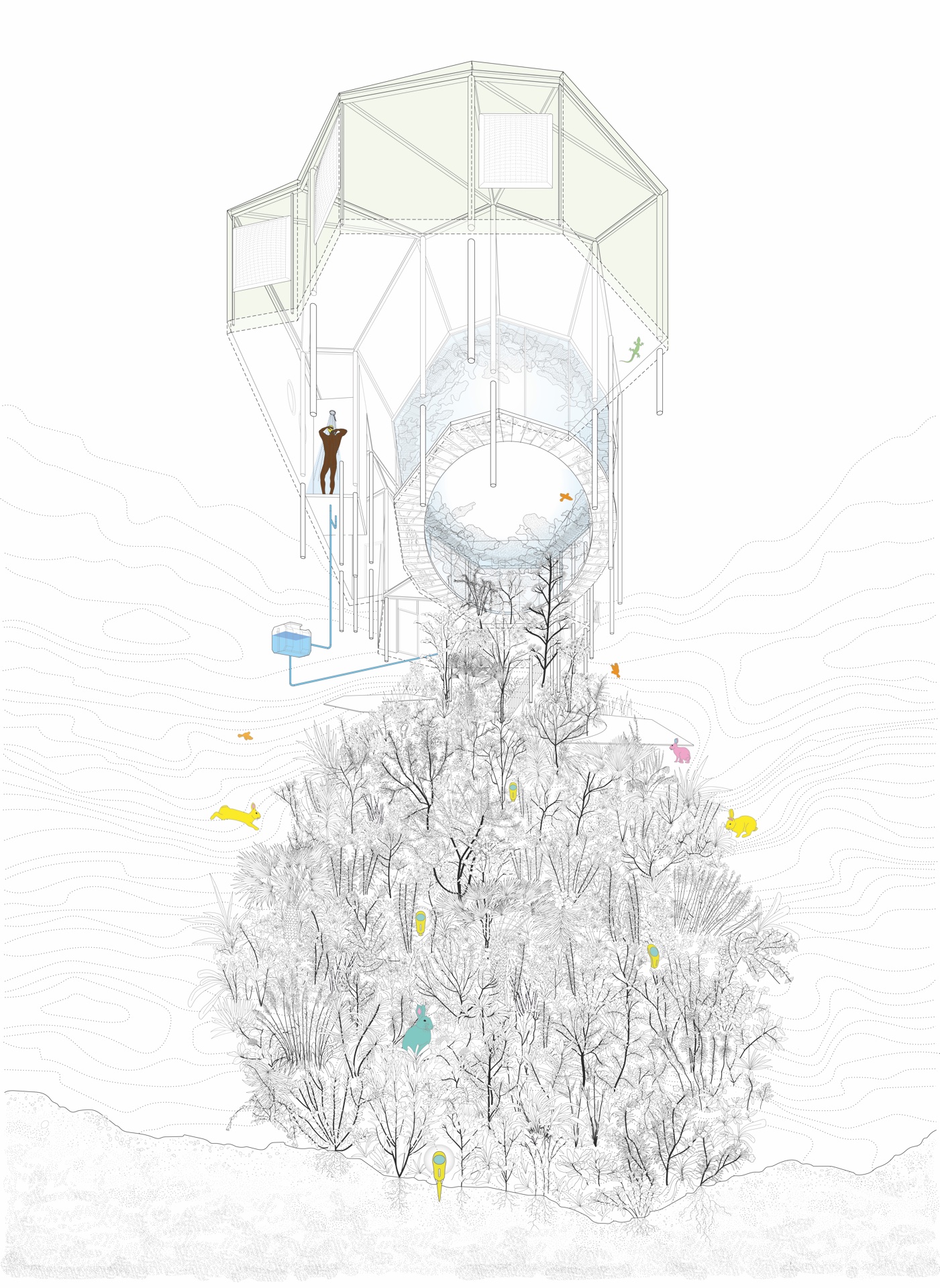
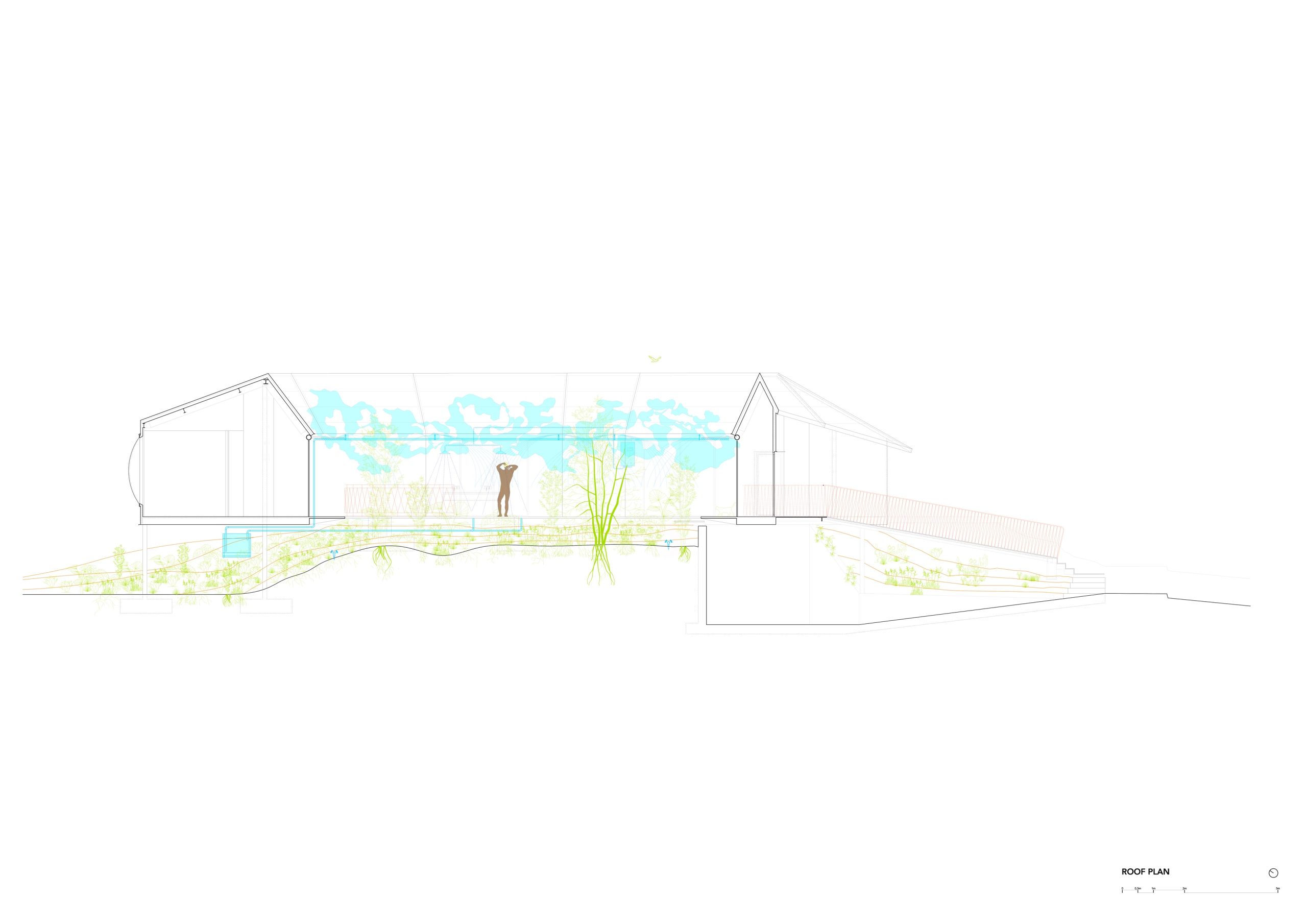
The Rambla Climate-House works as a climatic and ecological device. It is part of a series of associative initiatives at the scale of independent citizens, to contribute to reparations for the environmental and climate damage caused by over-urbanization. It collects pooled rainfall from its roofs and grey water from its showers and sinks to spray onto the rambla’s remains and regenerate their former ecologic and climatic constitution. Humidity and conductivity sensors activate an automatized meteorology that escapes the control of humans to reach the requirements of the reparation process. The house is organized around this elliptical section of rambla, as an observatory in alliance to this reconstructed landscape and as a sequence of interconnected spaces of different widths.
Following the reparation of the hydro-thermal conditions of the rambla, glimpses of its former more-than-human life have rapidly re-emerged after a one year period. Now, brachypodiums, myrtles, mastic trees, fan palms, oleanders, and fire trees grow in the elliptical section. Insects, birds, and lagomorphs find shelter in it.
Thermally, the construction of the house maximizes the energy efficiency. A marble bench around the elliptical section allows residents to cool off by allowing direct contact to the house’s thermal inertia. A coil exposed to the sun, crowning the elliptic section, provides passive hot water during the entire year.
about the category
We are at the time in which architectural design has the opportunity to explore ways of working collaboratively to address and contribute to face crucial challenges that are already affecting life all around the world; climate crisis, the drop of biodiversity and the forms of environmental and societal inequality that result from them. This house is part of a collective effort of activists, ecologists, and architects to explore ways for simple, ordinary architectural systems to contribute regenerating the hugely damaged ecosystems that institutionalize powers have proved to be uncommitted to repair. As such the house becomes an object of activism, intended to promote a change in the minds, and showing that an evolution in the way humans care for more-than-human life not only is possible but beautiful and enjoyable.